


Vibratory Screen Rescreening Service — Remeshing, Restoration, & Credit
Your frames, our expertise, massive savings. Professional screen restoration and remeshing — all frames qualify for service, select frames qualify for account credit.
Industrial Screen Technology in Modern Manufacturing
Industrial screen technology is integral to material separation, quality control and production efficiency across manufacturing environments. In vibratory screening systems, the screen media determines how accurately materials are classified, how consistently product specifications are met and how reliably throughput targets are achieved.
An industrial screen is more than a filtering surface; it’s a precision component engineered to manage particle size, flow rate and material behavior under constant vibration. When properly selected, industrial screens reduce downtime, improve product consistency and enable more efficient operations across food processing, chemical manufacturing, plastics, aggregates and other industrial settings.
Types of Industrial Screen Media Used in Screening Systems
Wire cloth screens are the most common option for vibratory screening. They provide high open area and precise particle separation, making them ideal for applications requiring tight size tolerances.
Self-cleaning sandwich screens are designed to minimize blinding and pegging when processing moist, sticky or near-size materials. By incorporating an intermediate cleaning layer, these screens help maintain throughput and prevent manual cleaning interruptions.
Perforated plate and punch plate screens offer increased durability in abrasive applications where impact resistance matters more than fine separation accuracy. Polyurethane and modular screen media are often used in high-wear environments, providing longer service life when processing aggressive or heavy materials.
ScreenerKing’s replacement screens are compatible with common industry-standard vibratory screener frames, so you can select the screen type that best fits your material handling and production goals.
How Industrial Screen Selection Impacts Performance
Selecting the correct industrial screen has a strong influence on system performance and product quality.
Open area affects throughput and separation efficiency; screens with higher open area allow more material to pass through while maintaining classification accuracy. Wire diameter and mesh count control particle size accuracy, so finer mesh improves separation precision but can require additional support or backing mesh for durability.
Blinding resistance is an essential component of many manufacturing processes. Self-cleaning designs and proper tensioning reduce buildup that can compromise efficiency and lead to unplanned downtime. Wear resistance also matters in continuous or abrasive applications, making it crucial to choose the appropriate alloy and screen construction.
Ultimately, a well-matched screen improves process optimization while minimizing maintenance demands and operational risk.
Matching Industrial Screens to Material and Application
Each screening application presents a unique set of challenges. Effective industrial screen selection accounts for material behavior, environmental conditions and production requirements:
- Materials with high moisture content or irregular particle shapes often benefit from self-cleaning designs that maintain open area during operation.
- Highly abrasive materials require stronger alloys and reinforced construction to prevent premature failure.
- High-capacity systems need screens optimized for throughput without sacrificing classification accuracy.
- Food and pharmaceutical processes may require encapsulation or secondary sealing to meet internal quality control and regulatory requirements.
ScreenerKing’s custom screen solutions help manufacturers align screen performance with specific operational needs.
Benefits of High-Quality Replacement Industrial Screens
Using high-quality replacement screens delivers measurable advantages across operations:
- Improved product quality through consistent separation accuracy
- Reduced downtime from longer screen life and fewer changeouts
- Better workplace safety by minimizing manual cleaning and screen handling
- Lower total cost of ownership through optimized wear resistance and performance
Precision-built industrial screens support stable processes, predictable output and improved efficiency across production lines.
Maintenance and Replacement Best Practices
Routine inspection and maintenance extend the lifespan of industrial screens and protect downstream equipment.
Screens should be inspected regularly for tension loss, wire fatigue and edge wear, as early detection helps prevent sudden failures that can disrupt production. Proper installation and secure fastening, including the use of compatible clamp rings, support consistent vibration and even material distribution.
Replacement schedules should consider both visible wear and performance changes, such as reduced throughput or inconsistent separation. When screens no longer meet performance requirements, timely replacement restores efficiency and protects product quality.
Industrial Screens, Automation, and Facility Safety
Modern manufacturing increasingly relies on automation and data-driven processes. Industrial screens integrate into automated material handling systems for real-time monitoring, process control and quality assurance.
In enclosed systems, including applications involving industrial doors, choosing the right screen contributes to dust containment, operator safety and environmental control. Reliable screening also improves consistency upstream and downstream, reducing rework and creating more predictable workflows.
Talk With an Industrial Screening Expert
The right industrial screen can boost your throughput, product quality and operational efficiency. ScreenerKing provides expert guidance, durable construction and solutions designed to fit common industry-standard vibratory screeners.
Request a custom quote or contact our team to discuss screen selection, customization options and replacement strategies for your application.
Screen FAQ's
Will your screens fit my screener?
We build screens that fit the common industry standard manufactured by all large and small North American vibratory screener companies.
How long will it take to get my ordered screens?
Turnaround time is contingent on the number and type of screens ordered and the existing workload. On average screens are built in 5–7 business days. We can expedite screens if needed and availability in the production schedule allows. Please call us if your need is urgent.
How much do screens cost to ship?
Screens ship from the East Coast and are shipped as parcels (18” 24” 30” 36” 40”) or as freight (48” and 60”). For 48” and 60” screens, freight cost per screen reduces dramatically as additional screens are ordered since they can be stacked on a pallet.
I have a screen but don’t know the mesh size/grade. Where do I find it?
Most screens will have numbers stamped into a metal plate embedded in the epoxy or engraved on the outer edge or center. Please contact us with that information so we can help you determine the size.
I am starting a new process and need help determining what size mesh to use.
A mesh number only tells the number of openings in a linear inch. The size of the opening is determined not only by the mesh number but by the size of the wire. Consult the mesh chart for more information.
What types of mesh alloys are available?
Our screen pricing is based on 304 Stainless Steel mesh but we can also build screens with 316 Stainless, T430 Stainless, and High Carbon. Please call or email for availability and pricing.
I am buying screens for a food safe process – do I need Epoxy with Encapsulation?
The epoxy is cured while the mesh is tensioned and some mesh will protrude through the epoxy on the outer edge. This mesh is cut and ground down to the surface of the epoxy, but small imperfections can remain. A secondary layer of epoxy seals those tiny imperfections. Please confirm with your internal Quality Manager to determine if encapsulation is needed.
ScreenerKing Round Separator Screens
ScreenerKing sells round separator screens in a variety of mesh sizes, alloys, and build specifications that are designed to fit the common industry standard frame sizes. Our screens will fit round vibratory screeners built by:
- Sweco
- Kason
- Midwestern
- Cleveland Vibratory
- And more!
Screen Size Specifications
| Nominal Screen Diameter | Screen Surface Diameter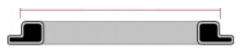 |
Lip Ring Diameter |
|---|---|---|
| 18" | 16" | 17" |
| 24" | 22 5/16" | 23 5/16" |
| 30" | 29 15/16" | 30 15/16" |
| 36" | 34 1/8" | 35 1/8" |
| 40" | 37 5/8" | 38 5/8" |
| 48" | 45 9/16" | 46 9/16" |
| 60" | 56 15/16" | 57" |
Lip Ring Profile
The drawing below illustrates a cross section of the specifications of the lip rings that are used in the production of the screens.

Mesh Selection - Replacing an existing Screen
Most separation processes have materials that determine the mesh required based on the size and nature of the material being processed.

Mesh Alloys
Our listed prices are for 304 Stainless Steel mesh, but we can also build screens with 316 Stainless Steel or T430 Nickel-free stainless.
Bonding the Mesh to the Lip Ring
Please consult the table below for bonding methods and common application considerations.

Other Screen Build Considerations
Center Hole – Screens with a center hole are needed when a center support is used in the vibratory screening machine.
Backing Mesh – Backing mesh is most commonly an 18 TBC (.009 Wire) that is used to support fine mesh (>100).