
Mesh and Wire Sizing Chart
This reference guide covers everything you need to know about mesh and wire sizing for vibratory screening. Use it to understand mesh designations, compare wire grades, convert mesh counts to micron openings, and find the right screen specifications for your application.
Interactive Mesh & Wire Sizing Reference Chart
Use the interactive chart below to look up U.S. Standard Sieve specifications, wire diameters, opening sizes in inches and microns, and percent open area across Market Grade, Mill Grade, and Tensile Bolting Cloth configurations. Scroll horizontally and vertically to view all data.
Open full chart in Google Sheets for easier viewing on mobile or for printing.
Shop by machine size
Know your separator's diameter? Get the exact screen.
Pick your machine size below — then choose mesh, alloy, and screen type right on the product page.
Understanding Mesh Designations
A mesh number indicates the number of openings per linear inch of screen material. For example, a "20 mesh" screen has 20 openings per inch. However, mesh count alone does not determine the actual opening size — the wire diameter plays an equally important role.
Two screens with the same mesh count but different wire diameters will have different opening sizes. This is why wire grade (Market Grade, Mill Grade, or Tensile Bolting Cloth) matters when selecting a replacement screen.

Mesh 101 Video
Mesh-to-Micron Conversion Chart
The table below shows common mesh sizes with their corresponding opening dimensions in both inches and microns across the three standard wire grades. Opening size decreases as wire diameter increases for the same mesh count.
| Mesh | Market Grade Opening (in / µm) | Mill Grade Opening (in / µm) | TBC Opening (in / µm) |
|---|---|---|---|
| 4 | 0.187" / 4,750 | 0.187" / 4,750 | — |
| 8 | 0.093" / 2,362 | 0.097" / 2,464 | — |
| 10 | 0.065" / 1,651 | 0.070" / 1,778 | — |
| 14 | 0.046" / 1,168 | 0.051" / 1,295 | — |
| 20 | 0.034" / 864 | 0.036" / 914 | 0.039" / 991 |
| 30 | 0.023" / 584 | 0.024" / 610 | 0.027" / 686 |
| 40 | 0.015" / 381 | 0.016" / 406 | 0.019" / 483 |
| 50 | 0.012" / 305 | 0.012" / 305 | 0.015" / 381 |
| 60 | 0.009" / 229 | 0.010" / 254 | 0.012" / 305 |
| 80 | 0.007" / 178 | 0.007" / 178 | 0.009" / 229 |
| 100 | 0.006" / 152 | 0.006" / 152 | 0.007" / 178 |
| 120 | 0.005" / 127 | 0.005" / 127 | 0.006" / 152 |
| 150 | — | 0.004" / 102 | 0.004" / 102 |
| 200 | — | 0.003" / 76 | 0.003" / 76 |
| 250 | — | — | 0.002" / 61 |
| 325 | — | — | 0.002" / 44 |
| 400 | — | — | 0.001" / 37 |
Wire Grade Comparison
The same mesh count is available in different wire grades. Each grade uses a different wire diameter, which directly affects the opening size and the screen's performance characteristics.
| Wire Grade | Wire Diameter | Opening Size | Best For |
|---|---|---|---|
| Market Grade | Thickest | Smallest (for given mesh) | Heavy or abrasive materials where durability is the priority |
| Mill Grade | Medium | Medium | General-purpose screening with balanced durability and throughput |
| Tensile Bolting Cloth (TBC) | Thinnest | Largest (for given mesh) | Fine powders and light materials where throughput efficiency is the priority |

Common Mesh Sizes by Application
| Application | Typical Mesh Range | Recommended Wire Grade |
|---|---|---|
| Scalping / De-lumping | 4–10 mesh | Market Grade |
| Granular Classification | 10–40 mesh | Market or Mill Grade |
| Safety / Check Screening | 20–60 mesh | Mill Grade or TBC |
| Fine Powder Separation | 60–200 mesh | TBC |
| Ultra-Fine / Pharmaceutical | 200–400 mesh | TBC |
| Liquid / Slurry Straining | 40–325 mesh | TBC |
Mesh Alloys
ScreenerKing screens are available in multiple alloys to meet different process requirements:
| Alloy | Properties | Common Uses |
|---|---|---|
| 304 Stainless Steel | Standard corrosion resistance, good all-around performance | General industrial, food, chemical processing |
| 316 Stainless Steel | Superior corrosion resistance, especially against chlorides | Pharmaceutical, marine, harsh chemical environments |
| T430 Stainless Steel | Nickel-free, magnetic, passes through metal detectors | Food processing with magnetic detection QC systems |
| High Carbon Steel | Maximum abrasion resistance, not corrosion resistant | Aggregates, minerals, highly abrasive dry materials |
Bonding Methods
The mesh is bonded to the lip ring using epoxy. The bonding method and any additional treatment affect the screen's suitability for different applications.

Encapsulation adds a secondary layer of epoxy over the outer edge to seal any small imperfections where mesh wire may protrude through the primary epoxy layer. This is typically required for food-safe and pharmaceutical applications. Confirm with your internal Quality Manager whether encapsulation is needed for your process.
Mesh Diagram Reference
The diagrams below illustrate mesh patterns from coarse (Mesh 1) to fine (Mesh 10), showing how wire count and opening size change as mesh number increases.


Screen Size Specifications
The table below shows the physical dimensions for each nominal screen diameter. Use these measurements to verify that replacement screens will fit your vibratory screener.
| Nominal Screen Diameter | Screen Surface Diameter | Lip Ring Diameter |
|---|---|---|
| 18" | 16" | 17" |
| 24" | 22 5/16" | 23 5/16" |
| 30" | 29 15/16" | 30 15/16" |
| 36" | 34 1/8" | 35 1/8" |
| 40" | 37 5/8" | 38 5/8" |
| 48" | 45 9/16" | 46 9/16" |
| 60" | 56 15/16" | 57 16/16" |
Screen Surface Diameter — fits inside the frame above the screen.
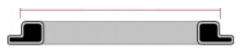
Lip Ring Diameter — sits atop the frame below the screen.

Lip Ring Profile — cross-section of the lip ring specifications used in screen production.

How to Read Mesh Designations on Your Screen
When ordering a replacement screen, you will need to identify the mesh count and wire grade from your existing screen. Here is where to look:
- Stamped metal plate — Many screens have a small metal tag embedded in the epoxy with the mesh number and wire specification stamped into it.
- Outer edge engraving — Some manufacturers engrave the specifications on the outer edge of the lip ring.
- Center ring markings — On some screens, the mesh information is stamped or engraved on the center ring or hub.
If you can locate the numbers but are unsure what they mean, contact ScreenerKing at (866) 265-1575 and we will help you identify the correct mesh size and wire grade for your replacement screen.
Opening Size vs. Wire Diameter
The relationship between mesh count, wire diameter, and opening size follows a simple formula:
Opening Size = (1 ÷ Mesh Count) – Wire Diameter
For example, a 20 mesh screen with 0.016" Market Grade wire:
- 1 ÷ 20 = 0.050" (distance between wire centers)
- 0.050" – 0.016" = 0.034" opening (864 microns)
The same 20 mesh with 0.011" TBC wire:
- 1 ÷ 20 = 0.050" (same distance between wire centers)
- 0.050" – 0.011" = 0.039" opening (991 microns)
This 15% larger opening with TBC wire translates directly to higher throughput, which is why wire grade selection matters as much as mesh count when specifying replacement screens.
Need Help Selecting the Right Mesh?
Our screen experts can help you determine the right mesh count, wire grade, and alloy for your application.
Call us at (866) 265-1575 or use our Mesh-to-Micron Conversion Calculator to explore mesh options.